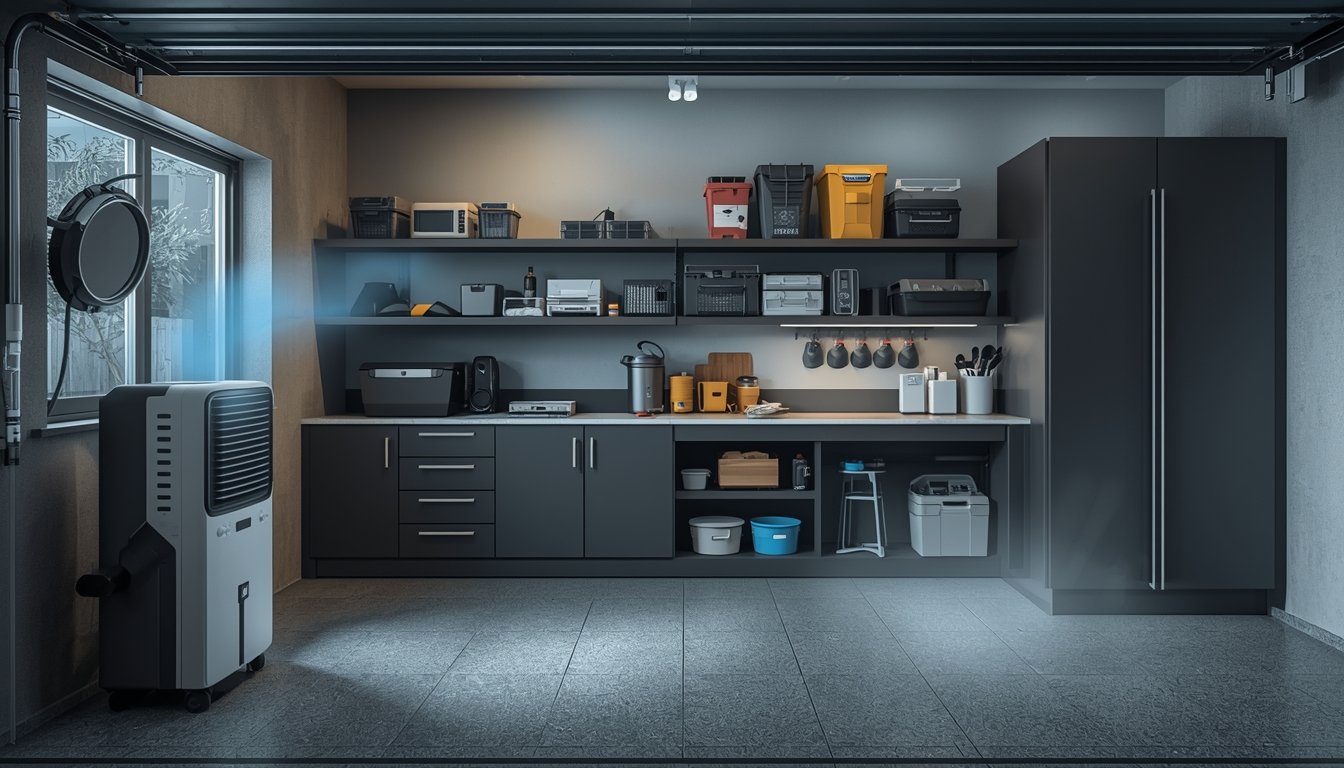
Refrigerant and desiccant dehumidifiers both remove moisture from the air, but they work in different ways and perform better under different conditions, especially in garages.
In most homes, this choice matters more than people expect. Garages often experience lower temperatures and higher humidity than indoor spaces, which means not all dehumidifiers will perform equally well.
Many people assume all dehumidifiers work the same, but the type you choose can have a noticeable impact on how effectively moisture is removed. Understanding the difference between refrigerant and desiccant models helps you select the right option for your garage environment.
To see how this fits into overall moisture control, it helps to start with what a garage dehumidifier is and do you really need one, as this explains how these systems work and why performance can vary.
How Refrigerant Dehumidifiers Work
- Use a cooling coil to condense moisture from the air
- Warm air passes over cold coils, forming water droplets
- Collected water is stored or drained away
- Work best in warmer temperatures
- Typically more energy efficient in moderate conditions
In most homes, refrigerant dehumidifiers are the most common type. They operate by drawing in humid air and cooling it until moisture condenses into liquid water. This water is then collected in a tank or removed through a drain.
A common issue is that these units rely on temperature to function efficiently. When the air is warm, they perform very well and can remove large amounts of moisture quickly.
However, in cooler environments such as garages, their performance can drop. If the temperature falls too low, the cooling coils may become less effective, reducing the unit’s ability to extract moisture.
Many people find that refrigerant units work well in garages that stay relatively warm throughout the year but struggle in colder conditions.
How Desiccant Dehumidifiers Work
- Use a moisture-absorbing material instead of cooling coils
- Pull moisture directly from the air without condensation
- Maintain consistent performance in cooler temperatures
- Release dry air back into the space
- Often quieter and lighter in design
Desiccant dehumidifiers use a different approach. Instead of cooling the air, they use a material that absorbs moisture directly. This process does not rely on temperature in the same way as refrigerant systems.
In most homes, this makes desiccant units more reliable in cooler environments. Garages that are uninsulated or exposed to lower temperatures often benefit from this type of dehumidifier.
A common advantage is that desiccant models continue to perform consistently even when temperatures drop. This makes them a strong option for garages in colder climates or during winter months.
Many people find that these units are particularly useful in spaces where temperature control is limited, as they maintain steady moisture removal regardless of conditions.
Key Differences That Matter in a Garage
The main difference between these two types is how they respond to temperature. Refrigerant units depend on warmer air to operate efficiently, while desiccant units are less affected by temperature changes.
In most homes, garages experience a wide range of temperatures throughout the day and across seasons. This makes the choice between the two types more important than it would be in a climate-controlled room.
Refrigerant models tend to be more energy efficient in warmer conditions, which can make them a good option for garages that do not get too cold. Desiccant models, on the other hand, provide more consistent performance in cooler environments.
Many people find that the best choice depends on how their garage behaves rather than just the size of the space.
Which Type Is Better for Your Garage?
- Choose refrigerant for warmer, more stable environments
- Choose desiccant for cooler or uninsulated garages
- Consider seasonal temperature changes
- Think about how often the garage is used
- Balance performance with energy efficiency
In most homes, there is no single answer that applies to every situation. The best option depends on the conditions in your garage and how you use the space.
A common approach is to choose a refrigerant model if the garage remains relatively warm and humidity is moderate. These units are widely available and often more cost-effective for everyday use.
For garages that become cold or experience significant temperature fluctuations, desiccant models are often the better choice. Their ability to perform consistently in cooler conditions makes them more reliable in these environments.
Many people find that understanding their garage conditions first leads to a better decision than simply choosing the most popular option.
Energy Use and Efficiency Considerations
Energy efficiency is another factor to consider when choosing between refrigerant and desiccant dehumidifiers. In most homes, refrigerant models tend to use less energy in warmer conditions because they rely on cooling rather than heating processes.
Desiccant units may use more energy overall, particularly because they often include a heating element as part of the moisture removal process. However, this trade-off is often worth it in cooler environments where refrigerant units struggle to perform.
Many people find that choosing the right type for their conditions results in better overall efficiency, even if the unit itself uses slightly more energy. A dehumidifier that works effectively will spend less time running continuously, which can balance out energy use over time.
Practical Considerations for Everyday Use
In addition to performance, there are practical factors that can influence your decision. Refrigerant units are often larger and heavier, while desiccant models tend to be more compact and easier to move.
Noise levels can also vary. In many cases, desiccant units are quieter, which may be important if the garage is attached to the home or used as a workspace.
Maintenance is generally straightforward for both types, but understanding how each system operates can help you use it more effectively. Choosing a unit that matches your garage conditions will always provide better results than trying to adapt the environment to the unit.
Conclusion
Refrigerant and desiccant dehumidifiers both offer effective ways to control moisture, but they are suited to different conditions. The key difference lies in how they perform at different temperatures, which is especially important in garage environments.
By understanding how each type works and matching it to your garage conditions, you can choose a dehumidifier that performs reliably and keeps humidity under control. This leads to a more stable space and better protection for everything stored inside.